Segeln wie vor 6.000 Jahren
(dg) Schon in der prädynastischen Naqada-Kultur Ägyptens begegnen uns Darstellungen großer Boote, die wahrscheinlich aus gebündeltem Pflanzenmaterial gebaut waren. Besonders spannend sind Hinweise auf frühe Segel sowie seitlich am Rumpf geführte Steuer- bzw. Schwertkonstruktionen – ein Prinzip, das bei unseren experimentellen ABORA-Fahrten eine zentrale Rolle spielt.
Unser Foto vom letzten Sommersegelcamp zeigt, was mit einem dreieckigen Quersegel und Seitenschwertern praktisch möglich ist: Ein Schilfboot muss keineswegs nur vor dem Wind segeln. Durch das Zusammenspiel von Segelstellung und Seitenschwertern lässt es sich hoch am Wind führen. Fast identische Felsbilder vom östlichen Mittelmeer über Gibraltar, auf Teneriffa und sogar auf Kuba legen einen maritimen Kulturaustausch nahe.
Experimentelle Archäologie macht aus alten Bildern überprüfbare Fragen:
Wie leistungsfähig waren die Schiffe der frühen Hochkulturen wirklich?
Mehr unter: www.abora.eu
#ABORA #ExperimentalArchaeology #Naqada #AncientSailing #ReedBoat #Seefahrtsgeschichte
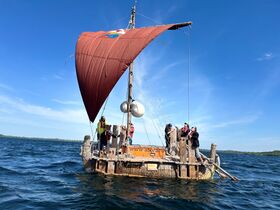
Probefahrt der DILMUN S auf dem diesjährigen Sommerfest 2026 in Braunsbedra. Halb am Wind testet sich die Crew an das neuartige Segel heran. Es ist eine Spezialanfertigung der Segelmacherei Tuchwerkstatt Hentschel aus Greifswald. Mit diesem Segeltyp wollen wir auf der nächsten ABORA V Mission zwischen den Kanarischen Inseln navigieren. //
Test sail of the DILMUN S at this year's summer festival 2026 in Braunsbedra. Sailing close-hauled, the crew familiarizes themselves with the innovative sail. It is a custom-made sail from the Tuchwerkstatt sailmaking workshop Hentschel in Greifswald. We plan to use this sail type for navigation between the Canary Islands on the next ABORA V mission.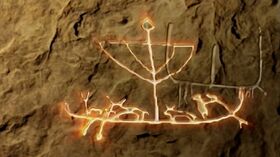
Reproduktion zweier vorgeschichtlicher Felsbilder der Naqada-Kultur aus Oberägypten. Die Darstellung zeigte mehrere nautische Innovationen. Neben dem Dreieckquer-Segel eben auch den Gebrauch von Seitenschwertern. Die hinter Darstellung brachte Görlitz auf die Idee, Schwerter nicht nur am Bug, sondern auch am Heck anzubringen. Die Beobachtung führte zum Erfolg der ABORA‑Seeexpeditionen. //
Reproduction of two prehistoric rock paintings from the Naqada culture in Upper Egypt. The depictions showed several nautical innovations, including the triangular transverse sail and the use of leeboards. The depiction in the rear also led Görlitz to install leeboards not only at the bow but also at the stern. This observation led to the success of the ABORA sea expeditions.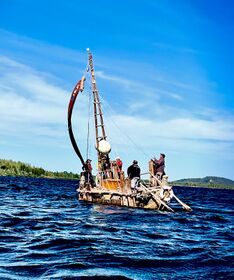
Ein weiteres Bild vom Geiseltalsee. Das Floß segelte von der Marina Braunsbedra in Richtung „Vogelinsel“. Wie auf vorzeitlichen Darstellungen sieht man, dass es mit dieser Takelage nur noch vier Crewmitglieder braucht, den Rahsegler auf Kurs zu halten. Das ist ein erheblicher Unterschied zum traditionellen Rahsegel, das viel mehr Crew zum Bedienen benötigt. //
Another picture from Lake Geiseltal. The raft sailed from the Braunsbedra marina towards "Bird Island." As depicted in ancient illustrations, this rigging shows that only four crew members are needed to keep the square-rigged vessel on course. This is a significant difference from the traditional square sail, which requires many more crew members to operate.


Sailing Like 6,000 Years Ago
Already in the Predynastic Naqada culture of ancient Egypt, we find depictions of large boats that were probably constructed from bundled plant material. Particularly fascinating are indications of early sails and lateral steering or leeboard-like devices – a principle that plays a central role in our experimental ABORA voyages.
The photo from our last summer sailing camp demonstrates what can be achieved with a triangular square sail and lateral leeboards: a reed boat does not simply have to sail before the wind. Through the interaction of sail trim and leeboards, it can sail surprisingly close to the wind. Nearly identical rock paintings from the eastern Mediterranean via Gibraltar, on Tenerife and even on Cuba suggest a maritime cultural exchange.
Experimental archaeology turns ancient images into testable questions: How capable were the vessels of early civilizations really?
More information: www.abora.eu
#ABORA #ExperimentalArchaeology #Naqada #AncientSailing #ReedBoat #MaritimeHistory
